domingo, 22 de febrero de 2015

Present Progressive

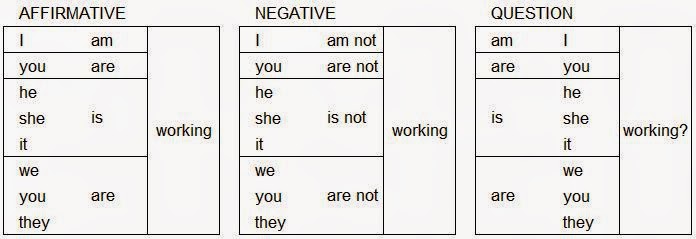
We use the present progressive when we refer to something that is happening now.

To write sentences using the present progressive you have to follow the following structure.

(+) Pronoun or noun + verb to be + verb ing + complement
(-) Pronoun or noun + verb to be + not + verb ing + complement
(?) Verb to be + Pronoun or noun +  verb ing + complement ?


Verb to be


viernes, 26 de octubre de 2012

present tense

The simple present tense in English is used to describe an action that is regular, true or normal.


The spelling for the verb in the third person differs depending on the ending of that verb:
1. For verbs that end in -O, -CH, -SH, -SS, -X, or -Z we add -ES in the third person.
  • go – goes
  • catch – catches
  • wash – washes
  • kiss – kisses
  • fix – fixes
  • buzz – buzzes
2. For verbs that end in a consonant + Y, we remove the Y and add -IES.
  • marry – marries
  • study – studies
  • carry – carries
  • worry – worries
NOTE: For verbs that end in a vowel + Y, we just add -S.
  • play – plays
  • enjoy – enjoys
  • say – says

Pronouns


jueves, 18 de octubre de 2012

Example


monkey

Name: It is a monkey.
color: it is brown.
Habitat: it lives in the jungle
Food: it eats bananas
body: it has a long tail.
Actions: It can climb
              It can't fly.